
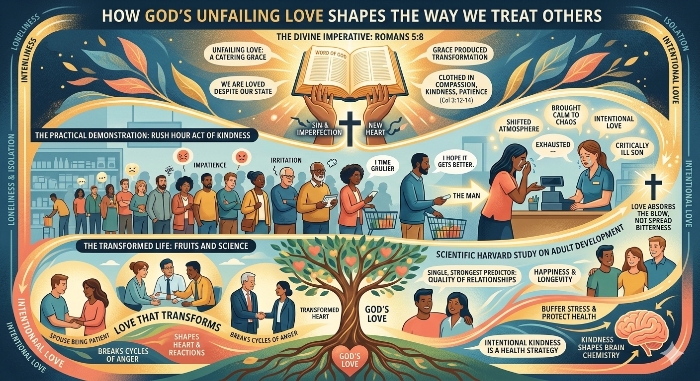
It was rush hour; the queue was long, and tension hung thick in the air. A woman ahead of everyone began to argue loudly with the cashier, causing even more delay. People were getting impatient, and irritation was spreading like wildfire. Then something unexpected happened.
A man stepped out of the line, walked to the counter, paid for the woman’s groceries quietly, and said, “I don’t know what today has been like for you, but I hope it gets better.”
The woman burst into tears in disbelief. Her son was critically ill in the hospital, and she hadn’t slept in 48 hours. Her outburst wasn’t because she was angry with the cashier for any wrong doing; it was because she was frustrated and exhausted over the ordeal of the last few days.
That moment of kindness shifted the atmosphere of the entire room and brought calm to the chaos that had become the woman’s life.
Loved When We Least Deserved It
Scripture tells us in Romans 5 vs 8 that, “God demonstrates His love toward us, in that while we were still sinners, Christ died for us.” Not after we improved, apologized, or promised to do better. Rather, while we were still messy, flawed, and inconsistent, God loved us. This is the kind of grace the man demonstrated at the supermarket that day.
From scripture, we can see that God didn’t wait for our transformation before loving us; He loved us despite our state. It was His love that produced the transformation. When this truth sinks in, it becomes impossible for us to treat people as though they must earn our kindness.
Clothed in Compassion
In Colossians 3 vs 12 – 14, we are instructed to “clothe yourselves with compassion, kindness, humility, gentleness and patience… forgive as the Lord forgave you… and over all these virtues put on love.” Notice the imagery: “clothe yourselves…, put on love” This underscores the fact that love is not a mood, grace is not a personality trait, and kindness is not reserved for “easy” people. They are garments we intentionally put on even when we do not feel patient, forgiving, or happy. We choose to love intentionally because we have been loved extravagantly.
The Hard Question
Have you had a hard time extending love as you should in recent times? Then it’s time to introspect and ask yourself, “Where do I struggle to extend grace? Is it:
* With a spouse who repeats the same mistakes?
* A colleague who undermines me?
* A client who is extremely difficult to please?
* The superior who disrespects me?
Scripture points to the fact that God’s love expressed through us: kindness, compassion, patience, changes lives both spiritually and physically. Scientific research confirms this as well. Studies from the University of Michigan have found that acts of kindness significantly increase emotional well-being for both the giver and receiver. Harvard’s longest running study on Adult Development, started in 1938, has tracked people from adolescence into late life, observing how their experiences, habits, relationships, and health play out over decades. The Harvard Gazette reveals that, “The SINGLE, STRONGEST PREDICTOR of long-term health, happiness, and even longevity wasn’t income, career success, fame, or education; it was the QUALITY of a person’s RELATIONSHIPS. It further revealed that people who felt connected, emotionally supported and close to others tended to:
- report higher levels of happiness decades later
- have better physical health in old age
- suffer less cognitive decline and
- live longer than those who felt isolated or in conflictual relationships
The findings weren’t about having many friends but about having rich, supportive connections, whether with family, spouses, close friends, colleagues, etc. This is important because acts of kindness and strong relationships aren’t just nice, they are health strategies:
- Being kind shapes your brain’s chemistry and emotional health
- Loving and supportive relationships buffer stress and protect physical health Together, they predict longer, more fulfilling lives.
In essence, if you embody the love that God shows you, you’re not just obeying scripture, you’re nurturing your soul and body in the process.
Dear believer, in a world increasingly marked by loneliness, where global surveys suggest that 1 in 4 adults report feeling persistently isolated, intentional love is not sentimental. It is transformational and grace is not weakness, it is spiritual strength under control.
Love That Transforms
God’s unfailing love shapes us in three profound ways:
1. It transforms our hearts
When we remember how patient God has been with us, it teaches us to extend patience to others and it becomes harder for us to stay harsh with them.
2. It changes our posture
Instead of asking, “How dare they?” we begin to ask, “What burdens or weights might they be carrying?”
3. It Breaks Cycles
Anger multiplies anger. Judgment multiplies shame. But grace disrupts patterns that could otherwise last for generations. So choose grace today and remember that the cross is proof that love absorbs the blow so that bitterness does not spread.
The Quiet Revolution of Intentional Kindness
Imagine homes where spouses compete in mercy, churches where forgiveness is swift, workplaces where compassion outweighs ego, and communities where people assume the best before believing the worst. That revolution doesn’t begin with a policy; it begins with a transformed heart and you can begin that revolution right where you are:
* Send the reconciliatory message
* Make the call
* Forgive the offense and let it go
* Pay the bill
* Offer the apology
* Speak kindly
That that step that demonstrates your intentionality to channel God’s love. If you’re having a hard time and would like God’s love to always shape the way you treat others, say this heartfelt prayer:
Lord, I want to love like you do. Soften my heart where it has grown hard. Shape my reactions until they become like Christ’s. Help me forgive as I have been forgiven and teach me to love practically.
The world has enough critics but it’s starving of carriers of grace. Perhaps the greatest testimony we will ever preach is from the way we treat the persons who least deserve it because this is exactly how God loves us.